
Automotive Alternator: A Complete Technical Guide
1. Overview
An automotive alternator (AC generator) is the main power source of a vehicle’s electrical system. It converts mechanical energy from the engine crankshaft into alternating current (AC), which is then rectified to direct current (DC) to supply all vehicle electrical loads and recharge the battery.
Unlike old-fashioned DC generators, alternators offer high efficiency, small size, light weight, good low‑speed charging performance, and long service life. They are standard on all modern cars, trucks, and engines.
2. Core Structure
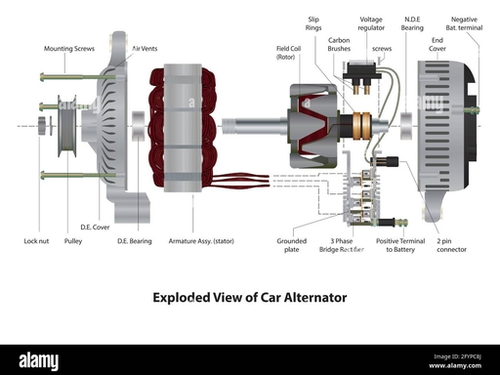
A typical alternator consists of five main components:
(1) Rotor
- The rotating magnetic field part.
- Includes: field winding, claw poles, slip rings, shaft.
- When excited by current, it creates a rotating magnetic field to induce voltage.
(2) Stator
- The power-generating component.
- Three groups of windings arranged at 120° to produce three‑phase AC.
- Fixed inside the housing, no sliding contact.
(3) Rectifier Bridge
- Converts three‑phase AC → DC for the vehicle.
- Composed of 6 or more silicon diodes.
- Prevents reverse current from the battery back to the alternator.
(4) Voltage Regulator
- Maintains output voltage stable (normally 13.5–14.5V).
- Controls the current in the rotor field winding.
- Can be internal (built-in) or external.
(5) Front & Rear Housings, Bearings, Pulley, Fan
- Support, cooling, and drive components.
- Pulley driven by engine V‑belt / serpentine belt.
3. Working Principle
- The engine drives the pulley and rotor to rotate.
- The voltage regulator supplies excitation current to the rotor winding → rotating magnetic field.
- The magnetic field cuts the stator windings → three‑phase AC voltage is induced.
- The rectifier bridge changes AC into DC.
- The voltage regulator adjusts field current to keep output voltage constant regardless of engine speed or electrical load.
4. Main Advantages of Alternators
- Better low‑speed charging: can charge battery even at idle.
- Higher power density: smaller and lighter than DC generators.
- Longer life: no brushes commutation (only small brushes for rotor excitation).
- More reliable: durable diodes and simple structure.
5. Classification
By mounting type
- Belt-driven alternator (most common)
- Integrated starter-generator (ISG/BSG) (new energy & start-stop systems)
By regulator position
- Internal regulator (compact, mainstream)
- External regulator (older vehicles)
By cooling
- Air-cooled (with fan)
- Water-cooled (high-power models)
6. Common Faults & Diagnosis
(1) No charging / Battery warning light on
- Causes: broken rotor winding, faulty regulator, blown rectifier diode, broken drive belt, poor wiring.
- Check: belt tension, battery voltage at idle (should rise above 13.5V).
(2) Overcharging (voltage >15V)
- Causes: faulty voltage regulator, shorted field circuit.
- Risk: boils battery, burns bulbs and ECU.
(3) Undercharging / Weak charging
- Causes: worn brushes, slip ring oxidation, loose connections, high resistance in wiring.
- Symptom: battery runs down slowly.
(4) Abnormal noise
- Causes: worn bearing, loose pulley, damaged fan, bent shaft.
(5) Leakage / Parasitic drain
- Causes: shorted diode, internal insulation damage.
7. Maintenance
- Check belt tension and wear regularly.
- Keep terminals clean and tight.
- Avoid overloading with high-power non‑original electrical devices.
- Replace brushes if length is insufficient (usually below 5 mm).
- Check charging voltage periodically: 13.5–14.5V is normal.
8. Selection & Replacement
- Match: voltage (12V/24V), rated current (A), pulley type, mounting holes, plug interface.
- Higher current is needed for cars with many electrical accessories.
- Ensure correct rotation direction and mounting clearance.
9. Development Trend
- High-efficiency & high-power: to support more ECUs, motors, and comfort systems.
- Smart alternators: controlled by ECU to save fuel.
- 48V mild hybrid systems: integrated BSG/ISG for power assist and energy recovery.
- Brushless & long-life structures: lower maintenance.
10. Conclusion
The alternator is the heart of the vehicle electrical system. It supplies stable power and keeps the battery healthy. Understanding its structure, working principle, faults, and maintenance helps ensure reliable vehicle operation and extend service life. With vehicle electrification, alternators are becoming more efficient, intelligent, and integrated.